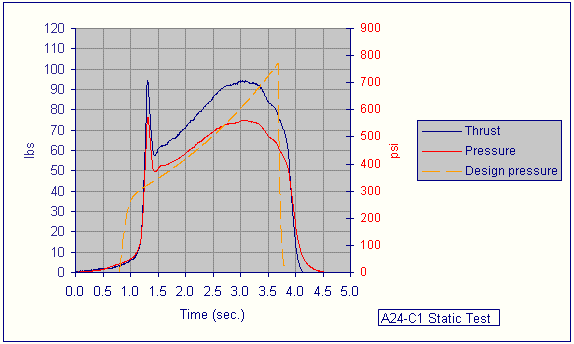
A24-A3 motor firing
 New bulkhead and nozzles
 New 38mm test motor
| Dec.2, 2007
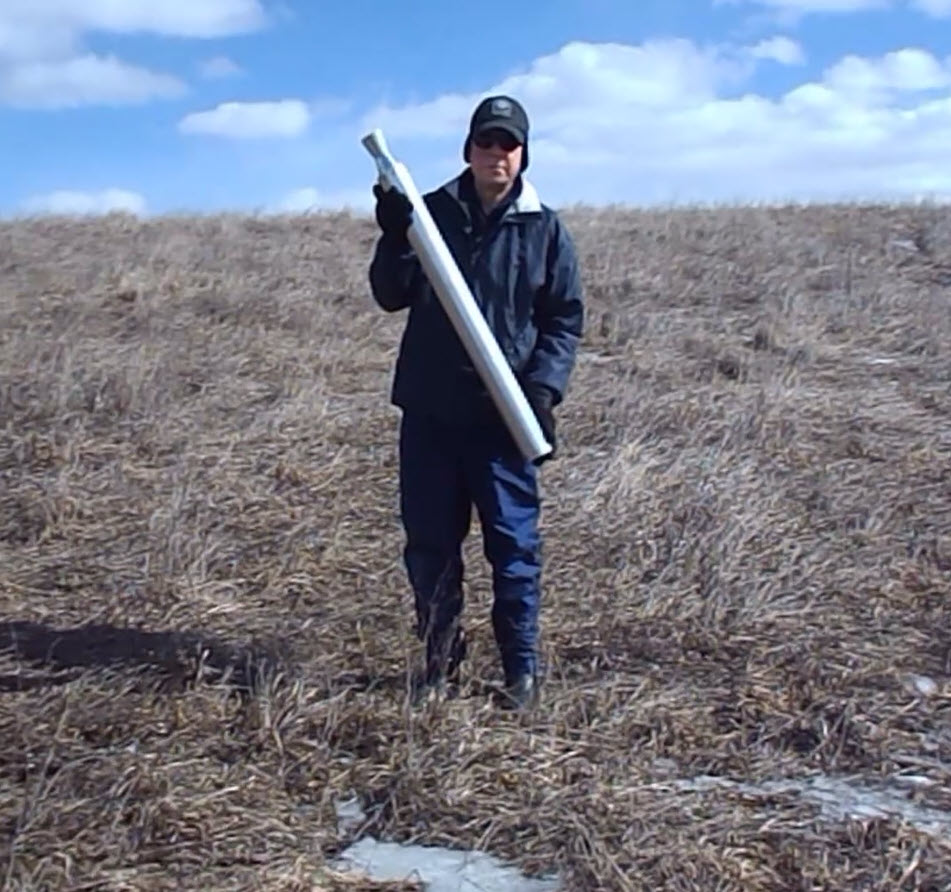
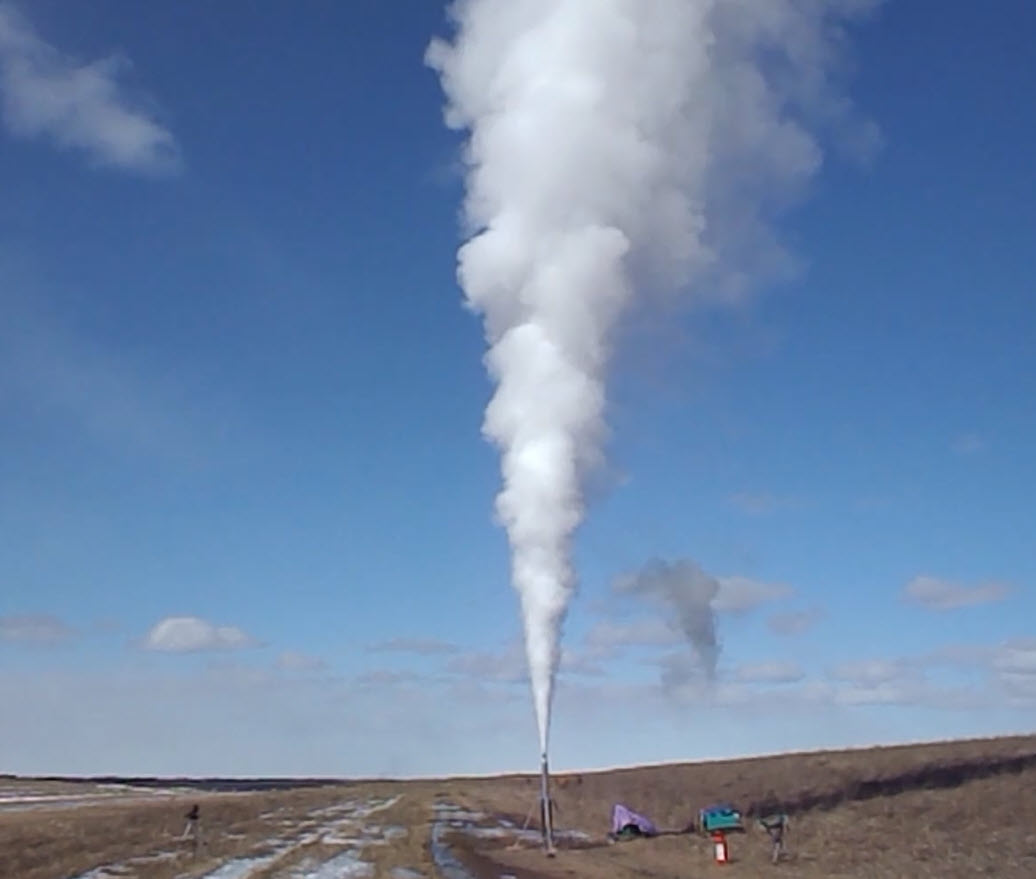
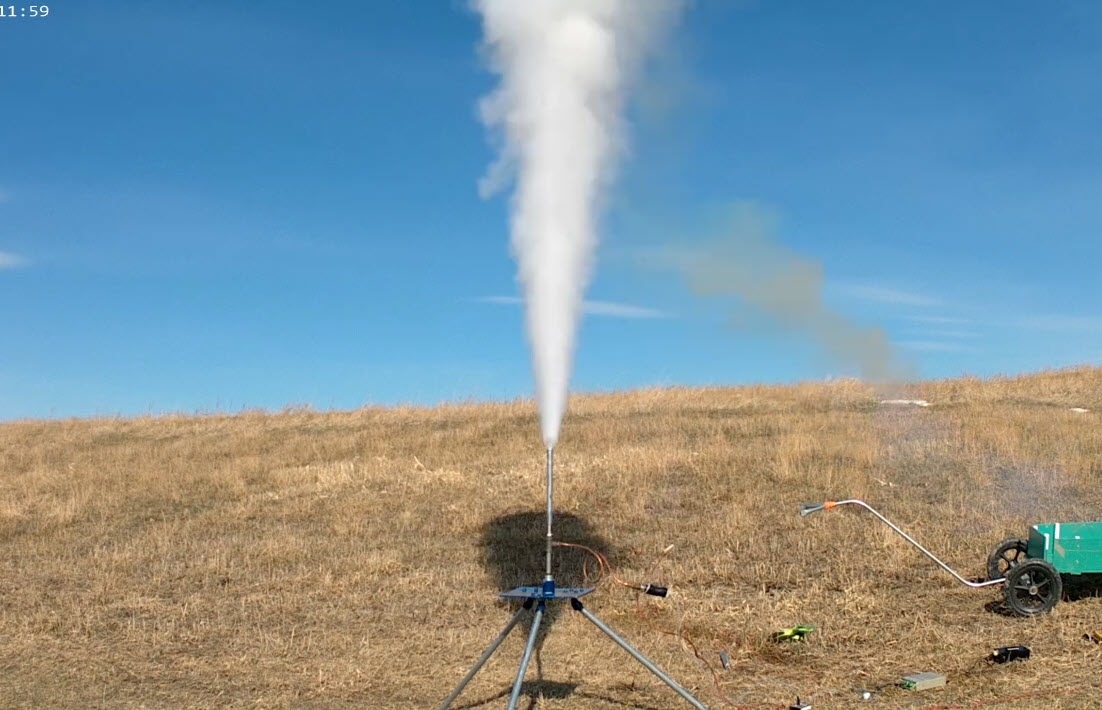
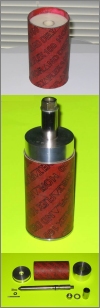
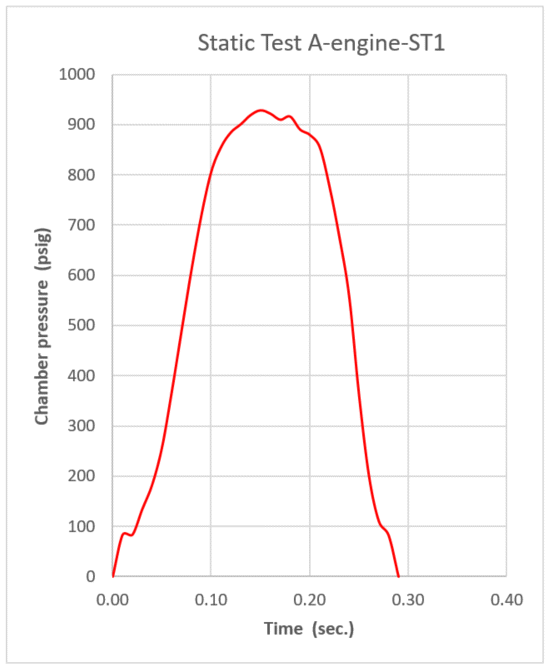
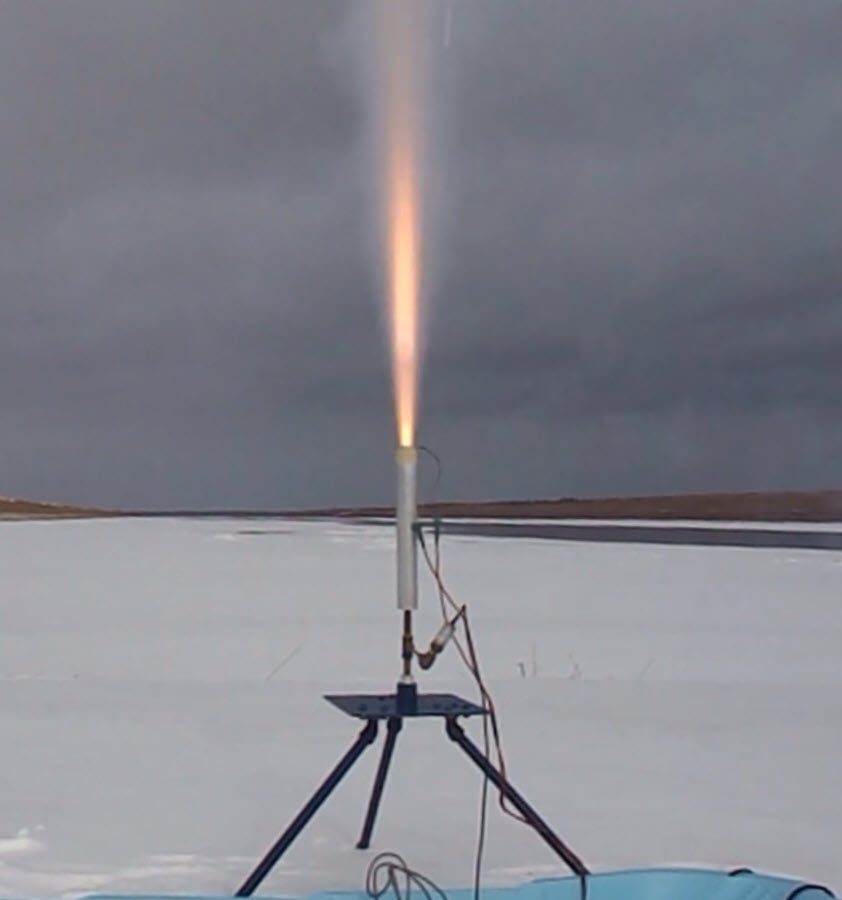
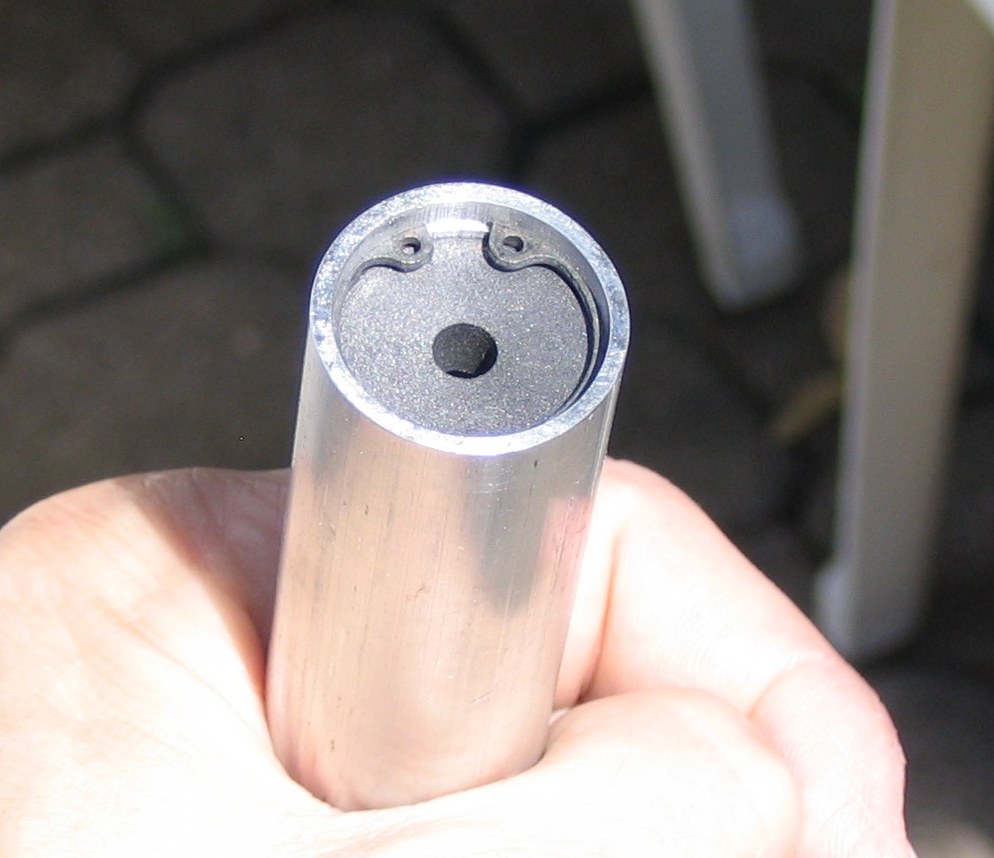
Another round of test firings was recently conducted with my experimental ammonium nitrate (AN) and aluminum (AL) formulations. One formulation worked particularly well, resulting in a stable burn with a nice foot-long white flame (see photo at left). Buoyed by this result, I have been working on a scaled-up, 38 mm motor that will be used as part of this on-going test program. This motor utilizes a graphite nozzle retained within a steel shell (photos at left). The steel parts have been giving a protective coating of "Tool Black", a tough protective finish of cupric selenide. This motor also features snap-ring retention for the nozzle and bulkhead. In addition to conducting these test firings, I am working on a new web page which will give full details of my experiments with AN-AL compositions.
Videoclip of static firing (1.2 Megbyte, wmv file).
New test motor, CAD drawing
|
 Experimental AN-AL motors
 A23-A6 motor firing
 Richard Graf setting up SSJ motor in test stand
| August 1, 2007
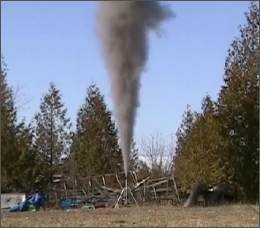
This past Saturday turned out to be a momentous day for my rocketry journal. Five motors were successfully fired, with excellent data collected. The previously proven SSJ motor was fired twice, providing useful erosive-burning data. The firings also demonstrated the viability of KNSB propellant prepared by the Vacuum-Evaporation method (which will be documented in a future web page). Also confirmed was the viability of a new method of casting KNDX propellant directly within inhibitor sleeves. The most exciting results came from the firings of my new motors powered by an experimental ammonium nitrate (AN) and aluminum (AL) propellant. Out of the five motors (see photo, top left), two failed to ignite. However, the other three ignited and burned rather well (photo, middle left), generating decent chamber pressure. The measured pressure was used to compute characteristic velocity (c-star) for the propellant, which was determined to be 4204 feet/sec (1281 m/sec). Not bad, for a first try. This roughly relates to an Isp of about 200 seconds, which should improve at higher chamber pressure. A lot more experimentation is needed before a practical propellant comes out of the effort, but this is an encouraging step.
Besides the novel propellant composition, the AN-AL motors were my first motors to utilize snap-rings for nozzle retention. Utilizing neoprene as a binder, the hollow-cylindrical propellant grain was formed by a hydraulic ramming technique in a case-bonded configuration. Complete details on these motors and propellant is slated to be featured in a future web page.
|
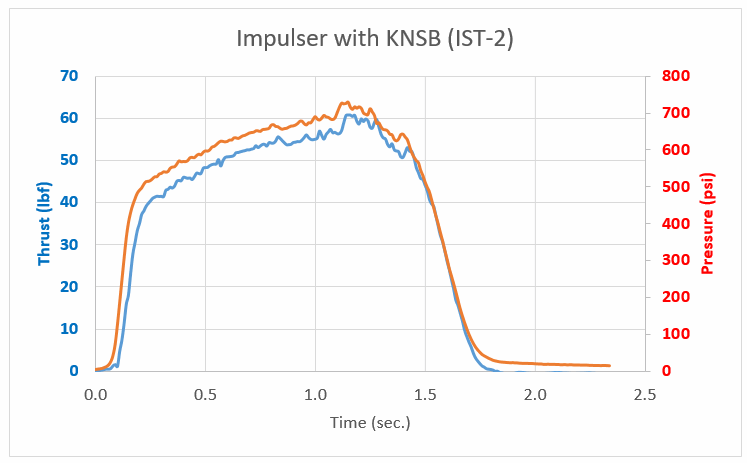
With a grain core diameter equal to the throat diameter, the six-segment SSJ motor (in stand, lower left photo) was expected to exhibit erosive burning. This was beautifully demonstrated in the measured pressure and thrust curves.
SSJ-4 KNSB motor thrust & pressure curves (English units)
(SI units)
(kind of cool how the measured curves exhibit that initial "kink" that matches the theoretical curve).
SSJ-5 KNDX motor thrust & pressure curves (English units)
(SI units) (classic signposts of erosive burning are the pressure exceedance at start-up and the extended tail-off).
Images: AN-AL Experimental Motors
Measured chamber pressure curves
Thermite pellets for initiating combustion
Experimental motors for testing "A" formulations
Internal view of motor showing case-bonded propellant grain
End view showing nozzle retained by snap-ring
End view showing Bondo-Glass bulkhead with pressure port
Graphite c-star nozzles
Hydraulic ram setup for press-forming grains within motor casing
Fornulations
Videoclips:
Videoclip of SSJ-5 Static test (835 kbyte, wmv file).
Videoclip of SSJ-5 Static test (1675 kbyte, mpg file).
Videoclip of A23-A4 Static test (1238 kbyte, wmv file).

| April 18-22, 2007
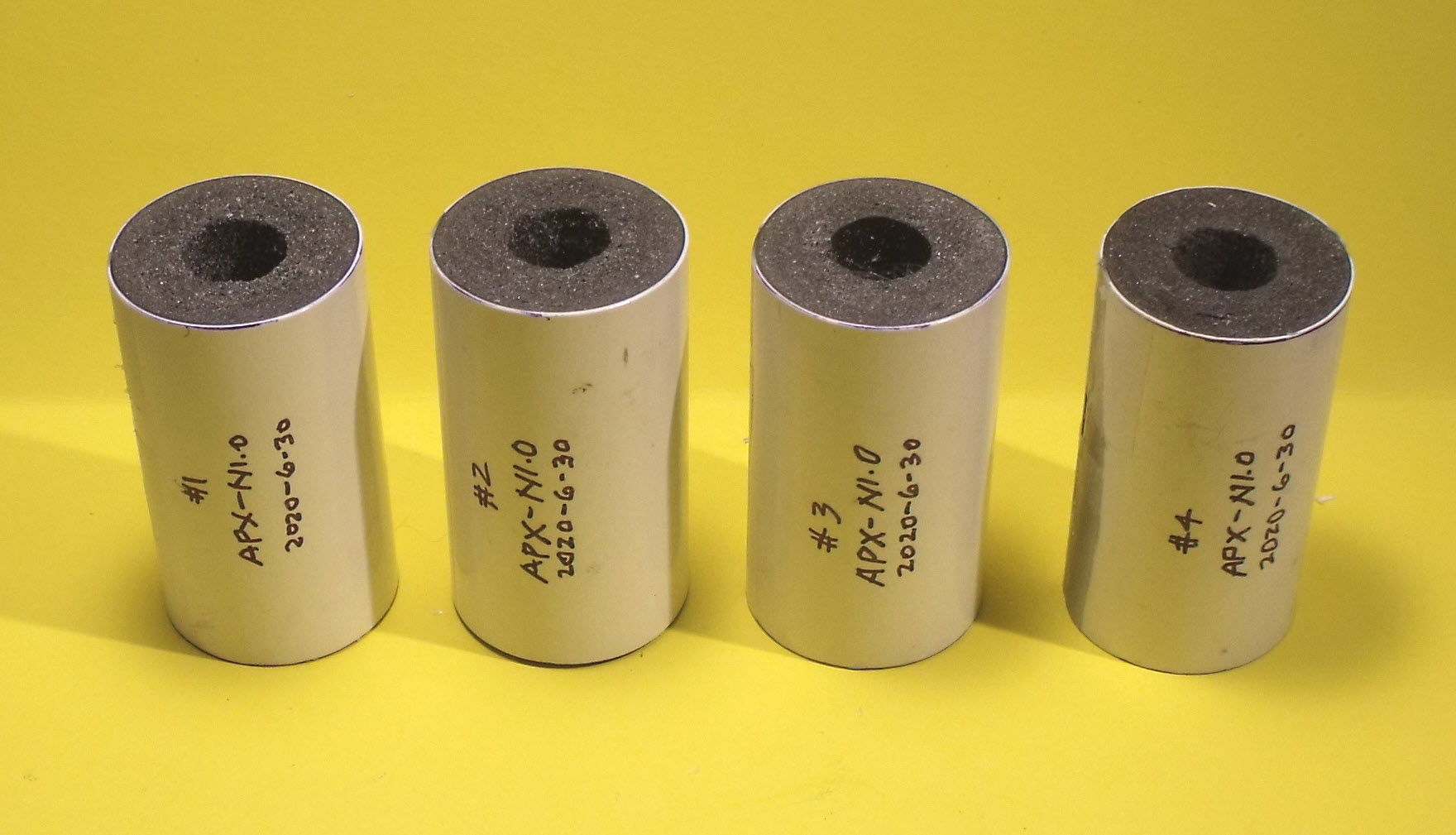
An on-going side project of mine has been to develop a successful AN (ammonium nitrate) based rocket propellant. Pictured at the left are some experimental grains that were recently prepared. Having a large aluminum content, this particular formulation burns with a hot, energetic flame in the open air, and has a theoretical Isp of about 245 seconds. I plan to attempt to test fire these charges in a rocket motor in the near future. These particular grains feature a special polymer binder and were formed with a high pressure compaction technique. The cores were subsequently drilled out.
|
The lower photo shows a half-segment loaded into an open-ended tube for a test burn.
Videoclip of burn test (1.3 Megbyte, wmv file).
Same videoclip, but in AVI format (3.1 Megabyte, AVI file).
| December 17, 2006
My newest SSJ "J-class" motor was successfully test fired on Dec.10th. Three firings were conducted (dismantling, cleaning and re-loading of the motor was pleasantly easy and troublefree). The main goal of the first two firings was to compare the effect of spacing between the six KNSB grain segments. The first firing had minimal spacing (1.5 mm) and the second firing had a much larger spacing (18.5 mm). The results were very interesting. The first firing results displayed the infamous "triangular" thrust profile. The second firing results, however, displayed a thrust profile very close to the design condition. These results suggest that the "triangular" thrust profile is a result of delayed ignition of the grain end faces (KNSB is known to be hard to ignite). Greater inter-segment spacing allows for turbulent flow to occur in the inter-segment region, facilitating ignition. Small inter-segment spacing provides a stagnant zone, which takes longer for ignition to occur at the segment faces. In addition to the SSJ motor, the A-100M motor was fired seven times, to collect data on the effect of potassium nitrate grade on performance. These results will be presented in a future web page.
|
Video clip of SSJ motor second firing (700 kb, wmv file).
Video clip of SSJ motor second firing, low-resolution (400 kb, wmv file).
PDF of SSJ motor drawing (24 kb pdf file).
| December 1, 2006
In the photo at left, I am holding my newest creation, a "J" class rocket motor that will be used primarily for studying erosive burning of sugar propellants (as described in the November 5th update). The cause of the odd "triangular" thrust profiles seen in many test results of KNSB (sorbitol propellant) will be also be investigated. The most recent hypothesis suggests that inadequate segment spacing may be responsible. The photo below illustrates three batches of six segments of KNSB propellant for this motor. The first three static tests will determine the effects of core size and of segment spacing. As well, I am continuing to gather data and test results on the influence of the potassium nitrate grade on propellant performance and burning characteristics.
|
| November 5, 2006
Impurites present in certain brands of potassium nitrate can have a detrimental effect when used in making sugar propellant. I am presently conducting some experiments to get a better understanding of this matter. In the photo at top left are three samples of KNSB (sorbitol) propellant made with three different brands of potassium nitrate. The sample in the middle is made using laboratory grade potassium nitrate. Findings will be published in a future web page.
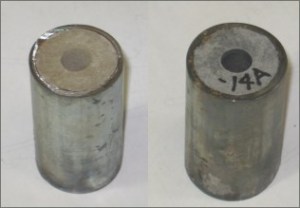
The middle photo illustrates the casting tubes that I recently manufactured for a new 38 mm, six grain motor that I will be utilizing to study (and hopefully characterize) erosive burning of KNSB propellant. The bottom left photo shows two of the grain segments that will be used in this motor. The key difference is the core diameter. The smaller core is the same size as the nozzle throat, and the larger core is 50% larger in diameter. The effect of intersegment spacing of this BATES configuration motor will also be studied. The first test firing of this new motor is expected in early December.
|
| September 30, 2006
A milestone in the Sugar Shot to Space Project was recently achieved with the successful test firing of the 1/4 Scale Ballistic Evaluation Motor (BEM) that was successfully test fired on September 23rd. This "M class" motor powered by 6.8 kg (15 lbs) of KNSB sugar propellant is unique in the sense that it is "restartable". After firing its first "phase", there is an 18 second delay prior to firing ot the motor's second "phase". Read the test report
|
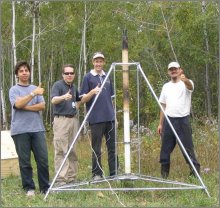
Photo: left to right, Tarun Tuli, Richard Nakka, Daniel Faber, Richard Graf
| September 4, 2006
When casting sugar propellant, shrinkage of the propellant during cooling can result in loss of bonding between the propellant and the casting tube. This can be a serious problem which can lead to overpressurization of the motor due to an unexpected increase in burning area. To overcome this problem, I've recently experimented with various casting techniques. A successful method, for sorbitol-based KNSB propellant, is shown here. The casting tube is made from a heat resistant gasket material which is sufficiently porous to allow the propellant to bond well. Additional bonding is achieved by first coating the inside of the casting tube with melted sorbitol. The key to reliable bonding, however, is the use of clamping pressure that is applied immediately after casting and maintained until the propellant has fully cured (typically 15 hours). The setup is shown in the photo at left. High propellant density in the order of 97% of theoretical density has been achieved.
Propellant segment
Casting fixture
Disassembled view
|
| June 19, 2006
To aid in the casting of sugar propellant, which can be quite viscous and hard to pour into a mould, I recently designed and built this vibrating platform. The motor mounted to the bottom of the platform rotates at 1725 RPM. An 80 gram offset mass on the pulley produces a 2G "packing force" in the vertical and sideways directions. The platform is pivoted at one end and rests on springs at the other end. The vibrating action additionally helps prevent the inclusion of bubbles or voids in the grain.
|
The black cylindrical part on top of the platform is a casting tube.
| June 4, 2006
This is a photo of a hand-operated "hydraulic pump" that was recently developed. The purpose of this pump, which uses water as a pressurizing medium, is for hydro-static pressure testing of rocket motors. This allows a completed motor to be safely tested to operating pressure (or greater) to confirm structural integrity and to check for possible leakage.
|
Prior to development of this pump, a regular grease gun had been used, but this proved to be messy and cumbersome.
This new hydraulic pump can also be used for checking the calibration of pressure gauges, and for calibrating pressure transducers.
Photo of Dismantled pump
Photo of piston assembly
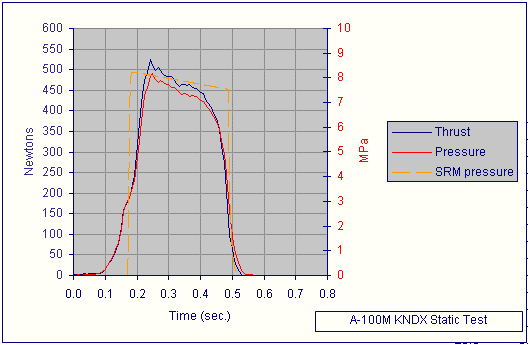
| April 14, 2006 Now that spring is here, static testing season has arrived once again. This past weekend featured eight test firings, including 5 tests of the A-100M motor with various propellant modifications, and the fourth firing of the L-class Liberty motor powered by epoxy-based RNX propellant (photo af left). Two of the A-100M experimental grains were produced using an innovative "vacuum-evaporation" method, which is being considered for use in the Sugar Shot to Space project (detailed in ssts_pdt_item6c.pdf). Also fired in the A-100M motor were two "sugar alloy" grains, as described in the Nov.19/2005 article below.
|
Video clip of Liberty motor firing, lo-resolution (519 kb, wmv file).
Video clip of Liberty motor firing, hi-resolution (1.32 Mb, wmv file).
Video clip of A-100M motor firing, lo-resolution (593 kb, wmv file).
Video clip of A-100M motor firing, hi-resolution (1.25 Mb, wmv file).
| November 19, 2005
Although the Sugar Shot to Space project has occupied much of my free time of late, I have nevertheless continued work on my own rocketry developments. At left is a photo of two A-100M propellant grains made of a sugar "alloy". The top grain was made using a mixture of 23% sorbitol plus 12% sucrose, and the bottom grain made using a mixture of 18% sorbitol and 17% sucrose.
|
Interestingly, both mixtures melt at nearly the same temperature as pure sorbitol, and cast similarly. One advantage is a quicker cure. The grain can be removed from the mould within a few hours. Both of these grains will be test fired in the near future.
Static firing in the STS-5000 test stand.
| June 23, 2005
The photo at top left is of a self-made "bomb calorimeter" apparatus. I constructed this apparatus for measuring heat of combustion of various materials such as polyester, epoxies, neoprene and other experimental propellant binders. Knowledge of the heat of combustion is useful for comparing energy content, and for determining formation enthalpy. Formation enthalpy (also known as heat of formation) is required as a key input parameter for chemical equilibrium software such as GUIPEP. Some of the experimental results are summarized in the table (middle left, click for larger image). The "A" series of propellants listed in the table are experimental ammonium nitrate/aluminum formulations.
At lower left is a photo of my motorized vacuum pump that I recently put together. After the handle broke off my hand-operated pump from overuse, I decided to motorize the pump. The motor that I used was salvaged from a discarded garage door opener. It was necessary to modify the motor housing by open up cooling holes, as the original design was intended for short duty cycle usage.
Other activities of late include presenting a lecture on AER to the Waterloo Space Society (in May) and more recently to a Canadian Space Society gathering, held at the University of Toronto.
|
| January 18, 2005
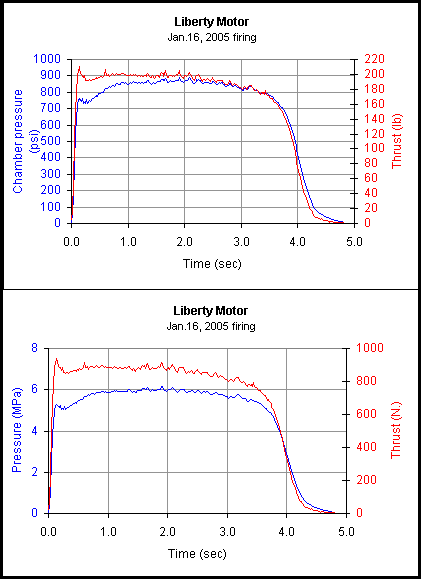
The new Liberty "L-class" solid rocket motor was successfully static tested on January 16, and performed flawlessly on its maiden firing! This is the largest motor that I have successfully tested, to date. The Liberty motor met its design goal, delivering 3337 Newton-seconds of impulse ( click for performance curve). The motor is powered by RNX-71V potassium nitrate/epoxy composite propellant in a "rod & tube" grain configuration.
Photos (from top, click on image for larger photo):
1.Author + Liberty rocket motor 2.
Static firing in the STS-5000 test stand.
Video clip of motor firing (834 kb, wmv file).
|
 | Dec.11, 2004 This is a photo of the nozzle which I recently machined for the new Liberty rocket motor that I designed and am currently fabricating. This 75 mm L-Class motor, which has a design impulse of over 3000 N-s., is intended to boost Frostfire Three to a targeted max velocity of mach 1.3. If successful, this will be my first supersonic rocket.
|


| October 11, 2004
As usual, there have been several activities and projects that have kept me overly busy of late. Perhaps the most interesting was a guest lecture I recently presented in Luleå, Sweden on the topic of Amateur Experimental Rockety. I will be presenting more details of this trip in a future web page. An interesting project that is coming to fruition is development of a Delay-Ejection Device (DED). It's a simple reloadable pyro-based delay and ejection charge that screws into the bulkhead of a motor. Ground tests have proven successful. Next is a flight test in my new SkyDart rocket, powered by the A-100M motor, which should be capable of lofting this rocket to over 2000 feet (600 m.).
Photos (from top, click on image for larger photo):
1. Lecture in Sweden 2.
DED
3. Author holding unfinished SkyDart
|


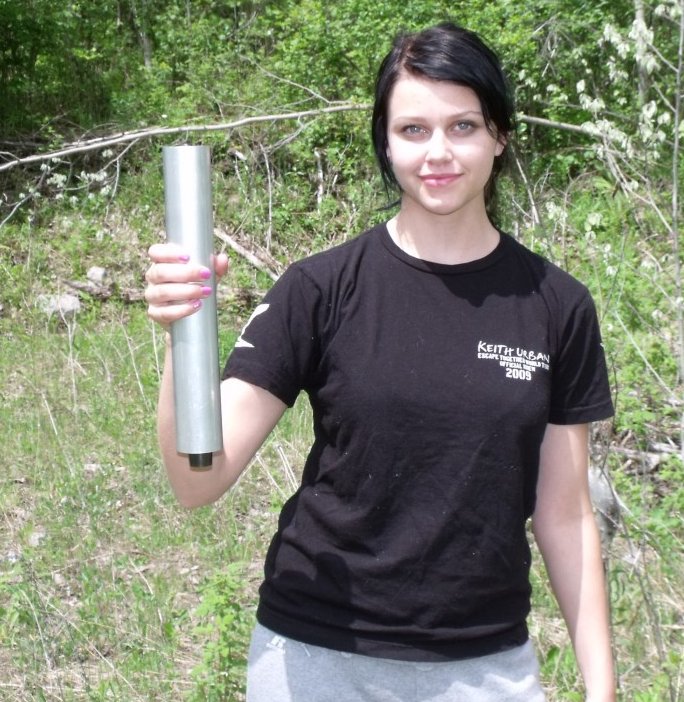
 | July 4, 2004 In the past 3 months since this "Preview" page was last updated I've been busy on a number of very interesting projects. I've developed the A-100M rocket motor, an updated version of the A-100. The main differences are the incorporation of o-rings for sealing, and that this version is mainly intended for use with KNDX and KNSB propellants. I've fired this G-class motor many times, and I've taken a rather keen liking to it. It is particularly suitable for experimenting with modified propellant formulations (it field-reloads in 15 minutes!), including various sugar propellants doped with oxides. I've also done development work on a new sugar propellant, based on fructose sugar. The key advantage to fructose is the low melting point and thinner viscosity. An ongoing project involves further development work in potassium nitrate/epoxy formulations, as well as AN based formulations.
Photos (from top, click on image for larger photo):
1. A-100M rocket motor 2. Various experimental grains for the A-100M
3. Author (left) with visiting Australian rocketry enthusiast, Shannon Dyer.
4. Static firing of a highly experimental aluminum enriched KN/epoxy formulation.
|
 | Mar.27, 2004 The flight of Frostfire Two made it apparent that for higher altitude flights, an effective means of making the rocket visible during descent is required. A number of methods will be investigated before the next Frostfire launch. In the photo at left is a flashing strobe light unit that was recently constructed in an effort to investigate whether this might be one solution. The strobe unit is made from a flash attachment for my old 35 mm Pentax. An alternative would be to use the flash components from a one-shot camera, but I chose this unit because it is quite a lot more powerful, operating off a 6V power supply (as opposed to 1.5V). The xenon strobe bulb is housed in a transparent nosecone fabricated from cast epoxy. The flash rate is set at once every 5 seconds.
|
 | This is the (unpainted) aft fuselage for my next rocket project. The hi-tech body tube and fins are fabricated from composite materials by my good friend Roman (composites expert). Made to my specifications, the fins have a NACA 0005 airfoil shape, and are constructed of carbon/kevlar reinforced epoxy skins, with syntactic foam core. Very stiff & extremely lightweight, no flutter with these fins! The fuselage is sandwich construction, also with carbon/kevlar reinforced epoxy inner & outer skins. Sandwiched between is an 1/8" (3 mm) phenolic honeycomb core. The fins are bonded onto the fuselage with structural epoxy (Scotch-Weld 2216), and will be proof-load tested in the near future.
|
 | Feb.14, 2004 This is the completed Frostfire Two rocket, which will be launched in the near future. It is quite similar to Frostfire One, launched early last year. The RNX powered Paradigm motor now has a slightly lengthened casing, holding 10% more propellant than the original design. Payload consists of the same PET (Parachute Ejection Triggering) module used with good success in the Zephyr rocket, the R-DAS flight data acquisition unit (and backup system for parachute deployment), and a radio transmitter. This unit will pick up & transmit sounds from within the rocket. An audio oscillator is mounted adjacent to the transmitter to provide a tracking signal.
The colour scheme was chosen strictly on the basis of visibility (clearly not aesthetics!), based on past experience. White shows up well against a blue sky, and darker colours (such as red & black) contrast well with a pallid sky.
|
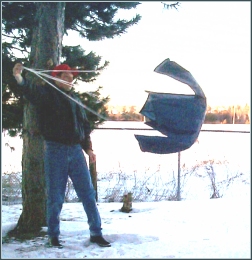
 | Jan. 24, 2004 Here I am "wind testing" the new "1 metre cross-parachute" that I just recently designed and fabricated. Construction technique is similar to the "1 metre semi-ellipsoidal parachute" that I designed some years ago. However, the cross-parachute is much easier & quicker to make. This parachute will be used on my next rocket, Frostfire Two. This rocket will be quite similar to Frostfire One, launched early last year (however, this rocket will not have induced roll!). Payload will consist of the R-DAS, the PET system in the Zephyr rocket, a transmitter (same unit that flew on Frostfire One) with a new audio beacon, and an Audio Data Recorder (ADR). The motor will be the Paradigm, which is capable of boosting the rocket to a one mile (1600 m.) apogee.
|
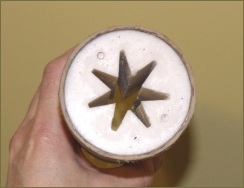
 | Nov. 23, 2003 Several things have been keeping my busy of late. Besides composing the CD of my website (on-going), finishing off my new Zephyr rocket, developing an AN/KP/epoxy formulation, I have also recently prepared an RNX-73 (KNCP) grain with a new geometric configuration. I call this a "pseudo-finocyl" (a true finocyl has fins that taper along the length of the grain). This configuration is quite easy to make. A central bore is drilled, then a saw is used to cut the fins (thanks to Dave Muesing for the concept).
|
 | Nov. 2, 2003 At left is a photo of the new Parachute Ejection Triggering (PET) module that I've just completed (click for hi-res photo). Three systems are combined in the one module: Air-Speed Switch for primary drogue deployment, Timer for backup drogue deployment, and a second Timer for Main Chute deployment. A number of design improvements have been incorporated, such as a redesigned lightweight g-switch and an epoxy encapsulated Mercury Switch for mercury containment in case of hard touchdown. Otherwise, the basic concepts are the same at the PET system used for the Boreas series of rocket flights. First launch of the yet-unnamed rocket will be in a few weeks from now.
|
 | Oct. 4, 2003 Recent static testing was conducted to determine if Mr.Fiberglass epoxy would be suitable for RNX propellant. This brand has the advantage of being nearly 40% cheaper than either West System or East Systems, currently in use. The photo shows the succesful firing of PCM-11 loaded with RNX-73 propellant, validating this brand of epoxy. Another plus is that vacuum treatment during production of the propellant is not required.
|
 | Sep. 2, 2003 The load cell (see below) worked like a charm. Together with the pressure data acquisition system, developed earlier, the thrust & chamber pressure curves for the Epoch motor were produced. The RNX-71V propellant also performed as hoped, confirming the design goal that this propellant be interchangeable with RNX-57. (Click for photo of test firing).
|
 | Aug. 23, 2003 This is a photo of a 200 lb. (900 N.) capacity load cell that I recently built (see Strain Gage
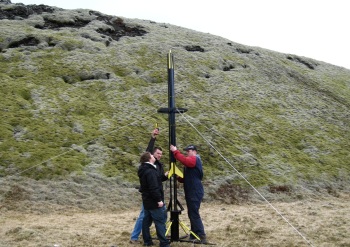
Load Cell for Thrust measurement). This load cell is fitted with four (full-bridge) strain gages and produces a nicely linear calibration curve. It has been mounted on the STS-5000 static thrust stand and will soon be used in conjunction with a pressure transducer utilizing the data acquisition system I built a few months back (see below) to collect both thrust and chamber pressure readings. This setup will be utilized in the static firings of the Epoch and Paradigm rocket motors loaded with RNX-71V propellant
|
 | Static firing of PCM-5 June 22, 2003 This was another characterization test of a slab grain of RNX-57 composite propellant. This motor had a Kn=700 and a propellant mass of 208 grams.
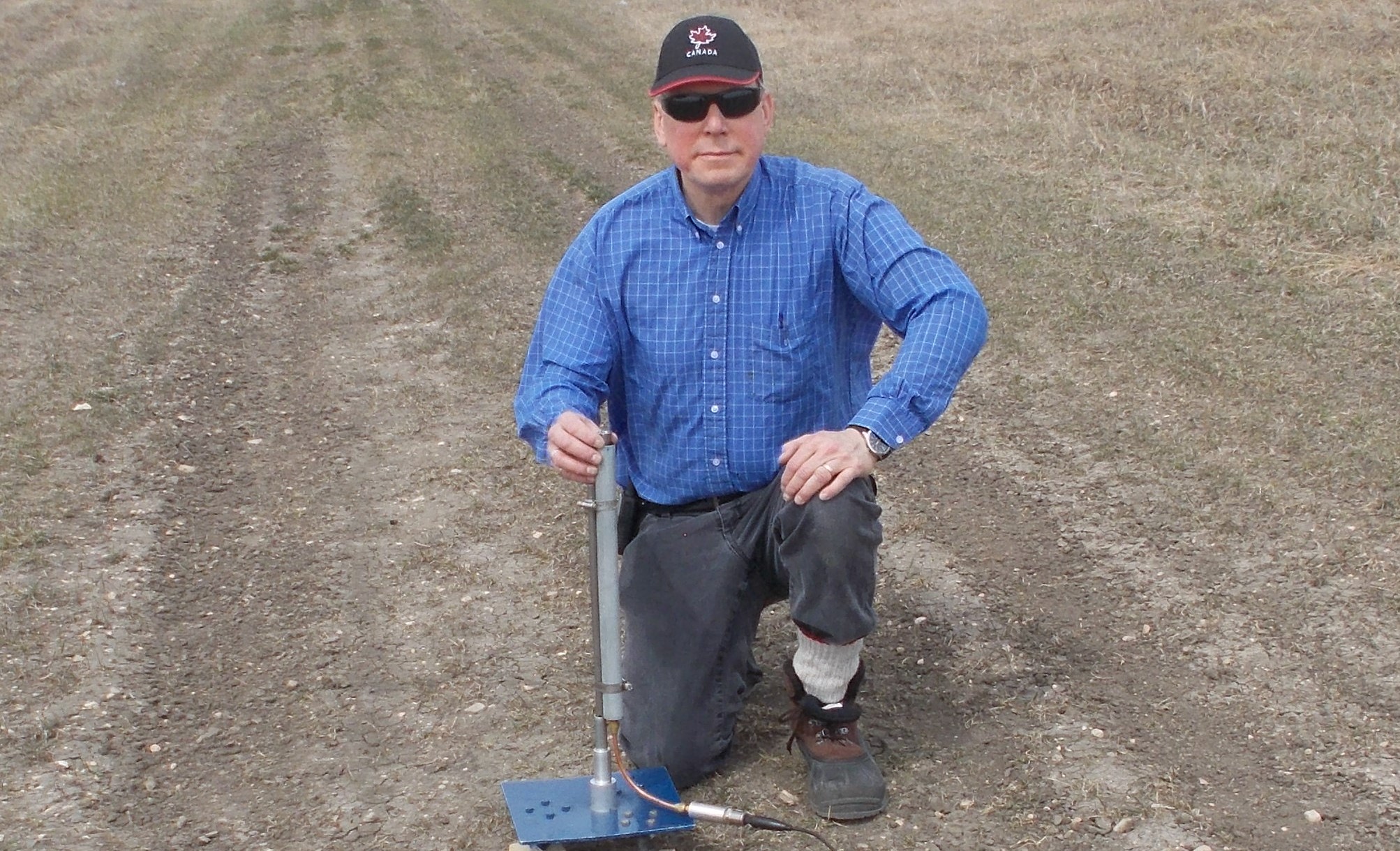
View video: PCM-5.WMV (272 kbyte, sound is kinda weird)
View video: PCM-5.MPG (1.7 Mbyte, better resolution)
|

Pressure-time plots of Slab motor firings with RNX-62 propellant
The above graph shows the measured chamber pressure for the two Slab motor static tests that were recently conducted (tests PCM-3 & 4). The Slab grains (see below) have a constant burning area (constant Kn) and it was expected (hoped!) that the pressure plots would reflect this with a more-or-less constant chamber pressure. Clearly, this "expectation" was dashed when I saw these curves...the pressure rises (nearly linearly) over the duration of the burn. Why? Inhibitor failure was ruled out after initial consideration. This behaviour has not been observed with RNX-57. After some head scratching, I recalled that RNX-62 was earlier noticed to be a lot more porous than RNX-57. Examination of the surface of the propellant under magnification revealed that RNX-62 has nearly 10 times as many minute bubbles or voids, estimated at 4000 per cubic centimetre (constituting about 10% of the propellant volume). Although these voids are very small (approximately 350 micrometre diameter), the large number of them may lead to a constantly increasing burning area (Kn) and an accelerated burn rate, explaining the odd pressure curves. The next "obvious" step is to determine the source of the bubbles (reaction between the West System epoxy & potassium nitrate, or some impurity...?).

Two PCM's (Propellant Characterization Motor) with "slab" grains
Two new static test motors were recently designed and built and will be used for characterizing the RNX propellants. These motors utilize slab (rectangular) propellant grains with inhibited edges, which provides for neutral burning. These slab grains are 1/2 inch (12.7 mm) thick. Key propellant characteristics such as chamber pressure as a function of Kn, burn rate as a function of pressure, and characteristic exhaust velocity (c-star) will be measured.

New data acquisition system
A new data acquisition system has been developed for use with the PCM series of tests. Currently, the system will be utilized for chamber pressure measurement only, but will later be enhanced to measure motor thrust, as well. A 0-5000 psi pressure transducer is connected to a simple INA122 based amplifier circuit, which in turn is interfaced to a DATAQ 154 A/D converter unit. This is controlled by software on the laptop computer, which also stores the test data.
The blue item in the photo is a manifold to which the pressure transducer, a 0-1000 psi digital pressure gauge, and a grease nipple are connected. This is used for calibrating the transducer...a grease gun supplies the necessary pressure.
 Epoch Rocket Motor -- "W-Variant"
Tailored to the faster burning RNX-62 epoxy composite propellant (utilizing West System epoxy), a BATES grain configuration was prepared. The casing was stretched to accommodate the 10% additional propellant, over the basic version of this motor which is powered by RNX-57. This motor was static tested on April 19th (ERMS-19). The results are shown in the graph below.

Static test results for ERMS-19
Only the chamber pressure was measured. The indicated thrust is based on the relationship F = Pc At Cf , where Pc is the chamber pressure, At is the throat area, and Cf = 1.4, the estimated thrust coefficient. As the chamber pressure is on the low side for the Epoch motor (which has a rated design pressure of 1000 psi), the Kn will be increased for the next test. However, this particular Kn and grain configuration would be just about right for a PVC motor, giving a really l-o-n-g burn time! Hmm, food for thought...
|