Rocket Motor Thrust and theThrust Coefficient
The thrust that a rocket motor generates is the most fundamental yardstick of performance. Without a doubt, this parameter is foremost in the mind of any amateur rocket motor designer. Thrust, being the force that a motor exerts, is what propels a rocket into (and beyond) the "wild blue yonder"!
Thrust is generated by the expelling of mass (the exhaust) flowing through the nozzle at high velocity. The expression for thrust is given by
 equation 1 equation 1where the left hand term in the equation represents the integral of the pressure forces (resultant) acting on the chamber and nozzle, projected on a plane normal to the nozzle axis of symmetry, as shown in the figure.
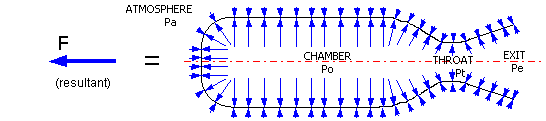 The internal pressure is highest inside the chamber and decreases steadily in the nozzle toward the exit. External (atmospheric) pressure is uniform over the outside surfaces. In the first term on the right-hand side of the equation, m is the mass flowrate of the exhaust products and ve is the exhaust velocity. The second term on the right-hand side is the so-called pressure thrust, which is equal to zero for a nozzle with an optimum expansion ratio (Pe=Pa); Ae is the nozzle exit area.
Considering continuity (conservation of mass) at the nozzle throat, equation 1 may be rewritten as
 equation 2 equation 2
This expression can now be modified using some equations that were presented in the Nozzle Theory Web Page, that is, the expressions for
- Fluid density ratio (noting that at the throat M=1),
 o / (eqn. 7) o / (eqn. 7)
- Critical (throat) flow velocity, v* (eqn. 3, noting that v*=a)
- Nozzle exit velocity, ve (eqn.12)
- and the equation of state for an ideal gas,

gives
 equation 3 equation 3
Derivation of Eqn.3 is given in the Appendix below.
This equation shows that, if the pressure thrust term is zero, thrust is directly proportional to throat area, A*, and is nearly directly proportional to
chamber pressure, Po.
This is particularly interesting. This means that if the throat size is doubled, the thrust will be doubled (if the chamber pressure is maintained). The same holds for the chamber pressure -- if it is doubled, thrust is approximately doubled. In reality, things are not so simple, as throat size and chamber pressure are tied together, as will be explained in the Theory Page on Chamber Pressure. This means that doubling a throat size would likely involve significant design changes, such as an increase in grain burning area. Likewise, if pressure is to be increased, the casing would have to be made stronger.
Thrust is also seen to be proportional to
- Pressure thrust (additive term, may be positive or negative)
- Ratio of specific heats, k. The sensitivity to k is quite low. For example, the difference in calculated thrust for k=1.4, compared to k=1.0, is a decrease of 14% (for a pressure ratio of Po/Pe=68).
- Pressure ratio across the nozzle, Pe/Po, as shown in the chart:
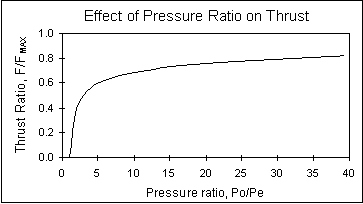 |
This chart plots the thrust ratio, F/Fmax, to the pressure (or expansion) ratio, where Fmax is the thrust that could be obtained with an infinite expansion ratio (i.e. expanding into a vacuum, with Pe=0). In the chart, the indicated thrust, F, excludes the pressure thrust term.The total thrust produced is given by Ftotal = F + (Pe-Pa) Ae.
|
The pressure ratio of the nozzle is determined solely by the area ratio, A*/Ae, as given by equation 14 of the Nozzle Theory page. What does this plot tell us?
- If the pressure ratio (and thus expansion ratio) is 1, then F = 0. The only thrust produced by such a nozzle is the pressure thrust, or Ftotal = (Pe-Pa)Ae. Such a nozzle, of course, would have no divergent portion, since A*/Ae=1, and would be a badly designed rocket nozzle!
- The slope of the curve is very steep initially, then begins to flatten out beyond Po/Pe = 5. This is significant, as it indicates that even a nozzle provided with a minimal expansion will be of significant benefit. With such a pressure ratio of 5, the resulting thrust is about 60% of maximum theoretical. From equation 14, it is found that the required area expansion ratio is only Ae/A* = 1.38 (for k=1.2), which translates to a required nozzle exit-to-throat diameter ratio of less than 2 !
The degree to which the thrust is amplified by the nozzle is quantified by the Thrust Coefficient, Cf, and is defined in terms of the chamber pressure and throat area:F = Cf A* Po equation 4The Thrust Coefficient determines the amplification of thrust due to gas expansion in the nozzle as compared to the thrust that would be exerted if the chamber pressure acted over the throat area only. Equation 4 is useful, as it allows for the experimental value of Cf to be obtained from measured values of chamber pressure, throat diameter, and thrust. The ideal value of Cf is calculated from equations 3 & 4, and shown below as equation 5:  equation 5 equation 5
A KN/Sucrose motor equipped with a well designed nozzle will deliver a Cf of about 1.5 under steady-state conditions. Ideal Cf for the same motor would be around 1.65. A large fraction of the loss is due to two-phase flow inefficiencies.
As a final note, it should be pointed out that the equations for thrust and Cf (eqns. 3 & 5) require that k be corrected for two-phase flow.
Worked Examples 
Worked Example #5 - Calculate the ideal Thrust and Thrust Coefficient for a rocket motor operating at 68 atmospheres chamber pressure and exhausts to ambient. The nozzle has a throat diameter of 10mm and has an exit diameter of 20mm. The nozzle exit pressure is 4 atmospheres. The propellant is KNSB.
Worked Example #5
Worked Example #6 - Calculate the ideal Thrust and Thrust Coefficient for a rocket motor operating at 68 atmospheres chamber pressure and exhausts to ambient. The nozzle has a throat diameter of 10mm and has an exit diameter of 35.7mm. The nozzle exit pressure is 1 atmosphere (optimum expansion). The propellant is KNSB.
Worked Example #6
Appendix
Derivation of Thrust Equation 3
|

