Rocket Motor Sizing – Example 3
A LoPer class EX
rocket is being designed to achieve an apogee of 500 metres. The applicable
design parameters are:
· Body diameter 70mm
· Dead mass of
rocket 3.27 kg
· Mass ratio target
1.07
· Average drag
coefficient 0.55
· Average motor
thrust 400 N.
· Propellant KNSB
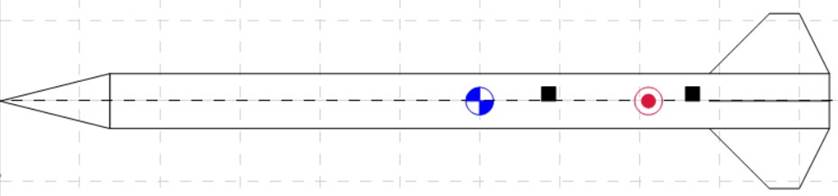
Figure 1 – Rocket Example 3
Problem Statement:
1.
Determine total impulse of motor to achieve target
apogee
2.
Determine propellant mass required
3.
Verify apogee prediction using RASAero sim tool
Solution:
(1) The total impulse
(I ) needed to achieve an apogee
goal (Zap) is given
by:
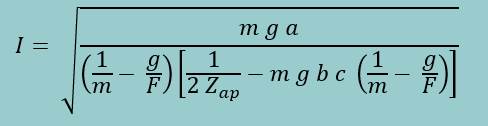
Zap = 500 m.
g = 9.808 m/sec2
F = 400 N.
a = 1.050
b = 0.00172
mo = 1.07 ´ 3.27 = 3.5 kg.
The average mass is calculated from eqn.7:

giving:



This represents a 20%
I-Class motor.
(2) The propellant (KNSB) has a specific impulse of
125 seconds. The mass of propellant, therefore, required to deliver a total
impulse of 384 N-sec. is:
mp = 384/(125´ 9.808) = 0.313
kg.
The liftoff weight will be slightly greater than
projected:
mo = 3.27 + 0.313 = 3.58
kg
The required rocket mass ratio is somewhat greater
than design target:
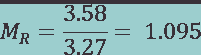
However, the average mass of the loaded rocket has
increased by about 1% (was 3.385 kg):

Will this have much effect upon the impulse
prediction? Let’s find out:

The predicted impulse is 1% higher than the original
prediction. As such, it is generally not necessary to repeat the impulse
calculation if the mass increases as small amount.
(3) RASAero app was used to simulate
the flight of the rocket. A rocket motor file was created to produce a total
impulse of 388 N-sec. (400 N.
thrust over duration of 0.96 seconds). The simulation tool was run and the
following result was obtained:
Max. altitude = 497
metres (1629 ft.) which is within 1% of the apogee goal.
References:
1. Rocket Motor Sizing webpage
2. Ex3.CDX1
3.
rasp_ex.eng