Fin Design – Example 1
A LoPer class
rocket is being designed. Clipped Delta profile has been chosen as a suitable fin
shape. To mitigate the potential for damage on landing, the fins will be
mounted somewhat forward of the aft end of the rocket body. The maximum altitude
is targeted to be 3300 feet (1000 metres) and maximum velocity is expected to
be 550 feet/second (170 m/s). The fins are to be 3D printed of PLA plastic as a
fin can and bonded to the rocket body.
All the rocket components have been designed except
the fins. The basic design of the rocket is shown in Figure 1. The items of
significant mass and their locations within the rocket are illustrated (red
balls) and have been tabulated and presented in Table 1.

Figure 1 – Rocket design showing items of mass and their x-station.

Table 1 – Items of mass and x-station
Note that the data for the Fin can are shown in red,
indicating that these are estimates.
Problem Statement:
1.
Size the fin profile to achieve a static Stability
Margin of 2.0
2.
Determine the fin thickness to achieve a strength
Safety Factor of 3.0
3.
Verify that the fins will not experience detrimental
flutter
Solution:
The static Stability Margin (SM)
is given by Equation 1

Re-arranging this equation to solve for C.P. location:

The first step is to determine the location of the fully-loaded rocket C.G. (xcg).
The C.G. location can be calculated knowing the mass of the rocket components
and their respective locations (x-station, relative to the nosecone tip). The
C.G. location is given by:

Where subscript i refers to each individual
component of mass and sigma (S) simply refers to the
summation of the individual (i) terms. Data
from Table 1 is expanded in Table 2 with a column showing the calculation of
the numerator. The sum of the individual masses and the sum of the numerator
terms is then tallied.

Table 2 – C.G. calculation
The summation terms are put into the equation and the location
of the C.G. is calculated:

The required location of the C.P. can now be
calculated to achieve a stability margin of 2.0:

Now that we know where the C.P. is to be located, we
can use an app such as AeroLab or Barrowman.xlsx to size the fins. The
results of this exercise are shown in Figures 2 and 3.

Figure 2 – AeroLab representation of rocket
with C.P. location indicated

Figure 3 – AeroLab fin detail for rocket
Once the fins have been fabricated and mounted on the
rocket, the true C.G. is then used to calculate the true Stability Margin. It
should be close to the value based on this exercise, but if not, the fins can
be clipped or a small amount of mass added to the nosecone to achieve the
desired Stability Margin.
The fins are next sized for structural strength using
Load Cases 3 and 4 shown in the Introduction
to Rocket Design - Fins webpage.


Load Case 3 is the critical flight
loading of the fins due to a restoring force generated normal to the
fin surface, a result of a sudden onset of non-zero angle of attack (example:
due to wind shear). Load Case 4 represents critical ground
loading of the fins (example: post-landing trauma or bumping a fin
while handling the rocket).
Case 3 is considered first. The location of the
individual fin spanwise C.P. is found from the following equation:

Where the terms are defined in Figure 15 of the Introduction to Rocket Design - Fins webpage. For our
fin, the value of these terms are:
S = 50 mm span
cr = 110 mm root chord
ct = 50 mm tip chord
Giving 
Falpha is equal to the finset
restoring force due to angle of attack and is given by:

where:

and the slope of the normal force coefficient for a single fin* is given by:

where the various terms are shown in the Figure below,
taken from he Introduction to Rocket Design -
Fins webpage.

Theta (θ) and l are the mid-chord sweep angle and mid-chord length,
respectively. And d is the reference diameter, in
this case, the nosecone base diameter.


We will conservatively assume an angle-of-attack of 10
degrees at Vmax.
α = 0.175 radians
We want the fin normal force to be in units of Newtons
so appropriate units of measure must be used for the terms involved. For air
density, we’ll use the nominal value of 1.225 kg/m3.
For our rocket, the value of these terms are:

D = 63.5mm or 0.0635 metres, giving
A = ¼ π (0.0635)2 = 0.00317 m2
This results in a normal force acting on a single fin
of:
N1F = 17701 (0.00317) 0.175
(2.22) = 21.8 N. or approximately 5 lbf., acting the the fin C.P. This
is the critical flight loading of a fin.
Load case 4 is considered next. For robustness of the
fins, we’ll assume a handling load of 50 N. (11 lbf) acting at the fin tip. By
inspection, this is more critical than than the flight case. As such, this will
be used to calculate the root thickness of our fin, which is the location of
maximum bending stress due to the handling load.
The root bending moment is:

And the root bending stress is given by

Where Z is the section modulus of the fin
cross-section at the root, which is taken to be rectangular.

As we want a Safety Factor (S.F.) of 3 based on
breakage of the fin, the relationship between bending stress and fin material
strength is:
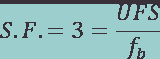
Where UFS is the Ultimate Flexurual Strength of the fin. The fin is to be
made of 3D printed PLA plastic. From this table;

UFS = 83 MPa
This is the strength of virgin PLA filament. To achieve maximum
strength, the filament must be extruded in the spanwise direction of the fin.
To account for inevitable (tiny) defects in the extrusion process, as well as
strength reduction due to moisture absorption, a knock-down factor of 0.8 will
be applied to this value, or UFSF =
0.8 (83) = 66.4 MPa
As such, the fin root thickness can be determined:

which is 2.6 mm or approximately 1/10 of an inch. The thickness,
if desired, can be tapered (if desired) toward the fin tip, starting at ½ span.
The fin should be ‘faired’ at the root for added strength and reduced body-fin
interference drag. The fin cross-section would look something like this:

Now that the fin cross-section has been designed for strength,
it is important to verify that the fins will not flutter, which can result in
catastrophic failure of the fins.
The method of Resource 27
Fin
Flutter Analysis (Revisited) by John
Bennett will be utilized. The flutter velocity is given by:

where

Since our fin is not symmetric, epsilon (ε)
will need to be calculated. The first step is to calculate the chordwise
centroid of the fin:

Plugging in the values for our fin:

The value for epsilon is calculated as such:

Which gives:

The value of Y may now be
calculated, noting that k = 1.4 and Po = 101.325 kPa.

The aspect ratio of the fin is given by (semi-span)2/fin
area, or:

Which gives:

The fin taper ratio (lambda) is tip chord length over root chord
length:
λ = 50/110 = 0.455
For the pressure ratio and speed of sound, we’ll use this table . At our predicted
altitude of 1000 metres:
a = 336.4 m/s
P/Po = 89.84/101.35 = 0.886
The shear modulus for PLA plastic is taken from here:
G = 1092 MPa but we must have it in the same units as pressure (Po) which is kPa:
G = 1092 MPa ´ 1000 = 1,092,000 kPa
The value for the estimated fin flutter velocity may now be
calculated:

The maximum predicted velocity for our rocket is 172
m/s, which gives us a Safety Factor for fin flutter failure of:
S.F. (flutter) = 261/172 = 1.52 or a 52% margin
Due to the assumptions and limitations of this flutter
analysis method, it is wise to be conservative and employ a Safety Factor of 2.
Repeating the analysis with a fin thickness of 3.2mm (1/8 inch) gives us
the desired Safety Factor of two.
_________
* See Reference 3.
References:
1.
Introduction to Rocket
Design: Fins
3.
The Theoretical Prediction of the Center of
Pressure (James S.Barrowman, Judith A. Barrowman)
4.
NACA-TN-4197 Summary of Flutter Experiences as a Guide to the Preliminary Design of
Lifting Surfaces on Missiles